
NZ Election 2026: What Could It Mean for the New Zealand Dollar?

If you’re planning to move money overseas, buy property in Australia or abroad, or pay an international supplier, New Zealand’s approaching election may have you wondering: should I transfer now, or wait until the result is known?
New Zealand’s 2026 General Election will be held on Saturday 7 November. An election can change economic expectations, but cannot reliably predict an exchange rate. The NZ dollar could rise, fall or show little lasting reaction, depending on the result, market expectations and overseas events.
For anyone with a real payment to make, the useful starting point is the amount, deadline and effect of a less favourable rate on their budget.
FX Market Insight | Prepared 13 October 2026
Key Dates For Your Calendar
Date | Event |
21 October 2026 | Overseas voting begins |
26 October 2026 | Advance voting begins in New Zealand |
28 October 2026 | RBNZ Monetary Policy Review and OCR announcement |
7 November 2026 | General Election |
The voting dates are confirmed by the Electoral Commission. The RBNZ lists its next OCR review for 28 October. These dates give people with sizeable transfers due from late October through November a useful window to review their plans.
Voting milestones are calendar context, not guaranteed currency catalysts. An interest-rate surprise may matter more to your exchange rate than the start of voting.
Three Possible Election Scenarios
Currency markets respond to changing expectations. An election can influence perceptions of the economic outlook, but the reaction depends partly on what investors already anticipated.
1. A broadly expected result
If the result largely matches expectations, the NZ dollar may show little sustained reaction. Markets could quickly return their attention to economic data and overseas events. An expected result is not a promise of a stable rate.
2. A surprise result
An unexpected outcome could prompt a sharper short-term move as investors reassess their expectations. That does not tell us whether the NZD would rise or fall, or whether an initial reaction would last. A move which benefits one transfer direction may disadvantage the opposite direction.
3. A lengthy government-formation process
If forming a government takes time, uncertainty could extend beyond election night. Markets may respond to developments along the way, although negotiations do not automatically mean a weaker currency. Knowing the provisional election result and knowing the eventual government are different milestones.
These are planning scenarios, not predictions or probabilities. There is no dependable rule that a particular party’s victory delivers a better transfer rate.
The RBNZ and Overseas Developments May Matter More
The 28 October OCR review falls just before the election. The decision and accompanying outlook could influence interest-rate expectations independently of politics.
RBNZ research shows that monetary-policy surprises can move exchange rates. Relative interest rates, commodity prices and global risk appetite also influence the NZ dollar. Those forces can outweigh domestic political developments.
Remember that you are exchanging two currencies. NZD/AUD reflects Australian developments too; NZD/USD includes US-dollar influences. Overseas central-bank decisions can therefore change your transfer rate even when New Zealand’s political outlook is unchanged.
What Would a Rate Change Mean For Your Transfer?
Imagine converting NZ$500,000 into Australian dollars for a property purchase or relocation.
Illustrative NZD/AUD rate | AUD received before costs |
0.80 | A$400,000 |
0.82 | A$410,000 |
0.84 | A$420,000 |
At 0.80 rather than 0.82, the same NZ-dollar amount delivers A$10,000 less.
For a fixed A$410,000 bill, the NZ-dollar cost rises from NZ$500,000 at 0.82 to approximately NZ$512,500 at 0.80.
If you are bringing A$410,000 into New Zealand, you would receive NZ$500,000 or NZ$512,500 respectively, before fees and provider margins. A weaker NZD can benefit this reverse transfer direction.
These rates are hypothetical, not live quotes or election forecasts. Figures exclude fees and provider margins.
Should You Transfer Before or After the Election?
There is no single answer that suits every transfer. Waiting could deliver a better rate, a worse rate or very little change.
Start with four questions:
When must the recipient be paid? A settlement date or invoice deadline limits how much flexibility you have.
Is the amount fixed in NZ dollars or foreign currency? That determines whether a less favourable rate reduces the amount received or increases your NZ-dollar cost.
How much movement can your budget absorb? Calculate the impact of several exchange-rate scenarios.
How much certainty do you need? A household completing a property settlement may value certainty differently from someone with a flexible transfer date.
A plan built around those answers is more useful than relying on a prediction about election night.
Five Practical Steps Before a Large International Payment
1. Work out your required amount and latest safe payment date
Allow time for account verification, source-of-funds checks, funding and the recipient’s bank to process the payment. Ask the provider about expected timings for your particular route rather than assuming a transfer will arrive immediately.
2. Test your budget against several rates
For a fixed foreign-currency bill, calculate how much NZD you would need if the rate improved or deteriorated. Include the provider’s actual quote and applicable fees in the final budget.
3. Compare the total outcome
A low advertised fee does not tell you the entire conversion cost. Compare how much arrives for the same amount sent, or the total cost of delivering the required foreign-currency amount. Obtain quotes close together in time so market movement does not distort the comparison.
4. Consider whether splitting the transfer fits your needs
Converting in portions reduces reliance on one day’s rate. It also means only part of the amount benefits if rates improve, and repeated payments may involve extra fees. Splitting is an option to assess, not a guarantee of a better average rate.
5. Ask about rate alerts and forward contracts where appropriate
An alert can help you monitor a chosen rate, but it does not reserve that rate or guarantee you can transact at it.
An eligible customer may be able to agree a forward contract with a provider for a future payment. This can provide exchange-rate certainty for the contracted amount, but it generally removes the benefit of a later favourable spot-rate move on that amount. Deposits, possible additional funding requirements and settlement obligations can apply. Confirm the terms and suitability directly with the provider.
Plan Around the Payment You Need to Make
The 2026 election is a reason to review your transfer plan, rather than assume that a better exchange rate will follow the result.
Know your required amount, allow time for onboarding and payment processing, and compare the rate and total cost offered by different providers. If you need greater certainty, ask what options are available for your circumstances and what obligations they involve.
The objective is to complete your transfer on terms that fit your needs, without making your property purchase, relocation or business payment depend on a political forecast.
NZD/AUD Chart: The Wider Picture Before the Election
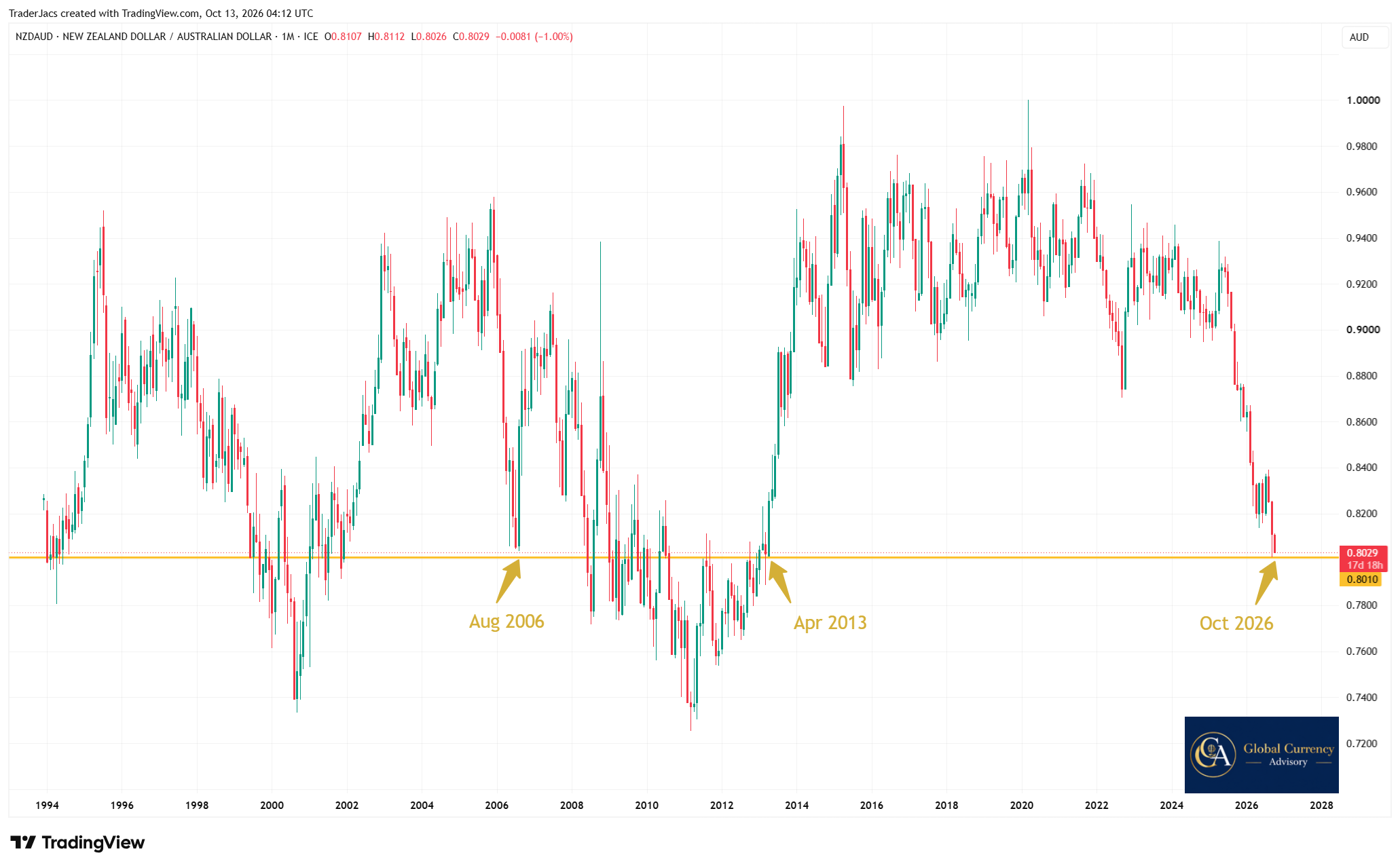
What does this chart mean for your money transfer?
The chart above shows the New Zealand dollar trading near 0.80 against the Australian dollar. This means NZ$1 buys approximately A$0.80 before transfer costs.
Each bar represents one month. Since June 2025, when the exchange rate was around 0.93, the NZ dollar has weakened against the Australian dollar.
For someone moving money from New Zealand to Australia, that makes a substantial difference. Using NZ$500,000 as an example:
At 0.93, you would receive A$465,000.
At 0.80, you would receive A$400,000.
That is A$65,000 less from the same NZ-dollar amount, before fees and provider margins.
Why is the 0.80 level worth watching?
The chart shows that the exchange rate has recovered from around 0.80 on previous occasions. For example, after reaching this area in August 2006, it rose towards 0.93 over the following year.
Traders sometimes call an area like this “support” - a level where previous falls have slowed or reversed.
However, the exchange rate has also traded below 0.80 for extended periods, particularly between 2008 and 2013. This makes 0.80 an area worth watching, rather than a floor or a guarantee that the NZ dollar will recover.
What could this mean for you?
If you are sending NZ dollars to Australia, a further fall would mean receiving fewer Australian dollars. A recovery would mean receiving more.
If you are bringing Australian dollars into New Zealand, the effect works the other way: a weaker NZ dollar generally gives you more NZ dollars for the same Australian-dollar amount.
The chart provides useful context, but it cannot tell us whether the next move will be up or down - or what rate will be available on your payment date. Your budget and deadline still need to guide your planning.
Chart commentary is general market information, not a recommendation to trade or transfer at a particular level.
Global Currency Advisory provides general information and educational content only. This article does not constitute personal financial, investment, tax or legal advice. Exchange rates, fees, product availability and eligibility vary by provider, jurisdiction and transaction.


